As a couple
Couple chart: what comparing two skies shows, and what it does not
Two people, two skies, one table. What appears when you lay the two charts over each other, and why no score should come out of it.
Type "love compatibility" into a search engine, enter two birth dates, and you get a number. 74 percent. 91 percent. A heart, half full or brimming. It is tempting, because the question behind it is so large: are we right for each other? Do we understand each other? And if not, why not?
Astrology has a long tradition with this question. A percentage is not part of it. What a comparison of two birth charts can show is richer than a score, and humbler.
What a couple chart compares
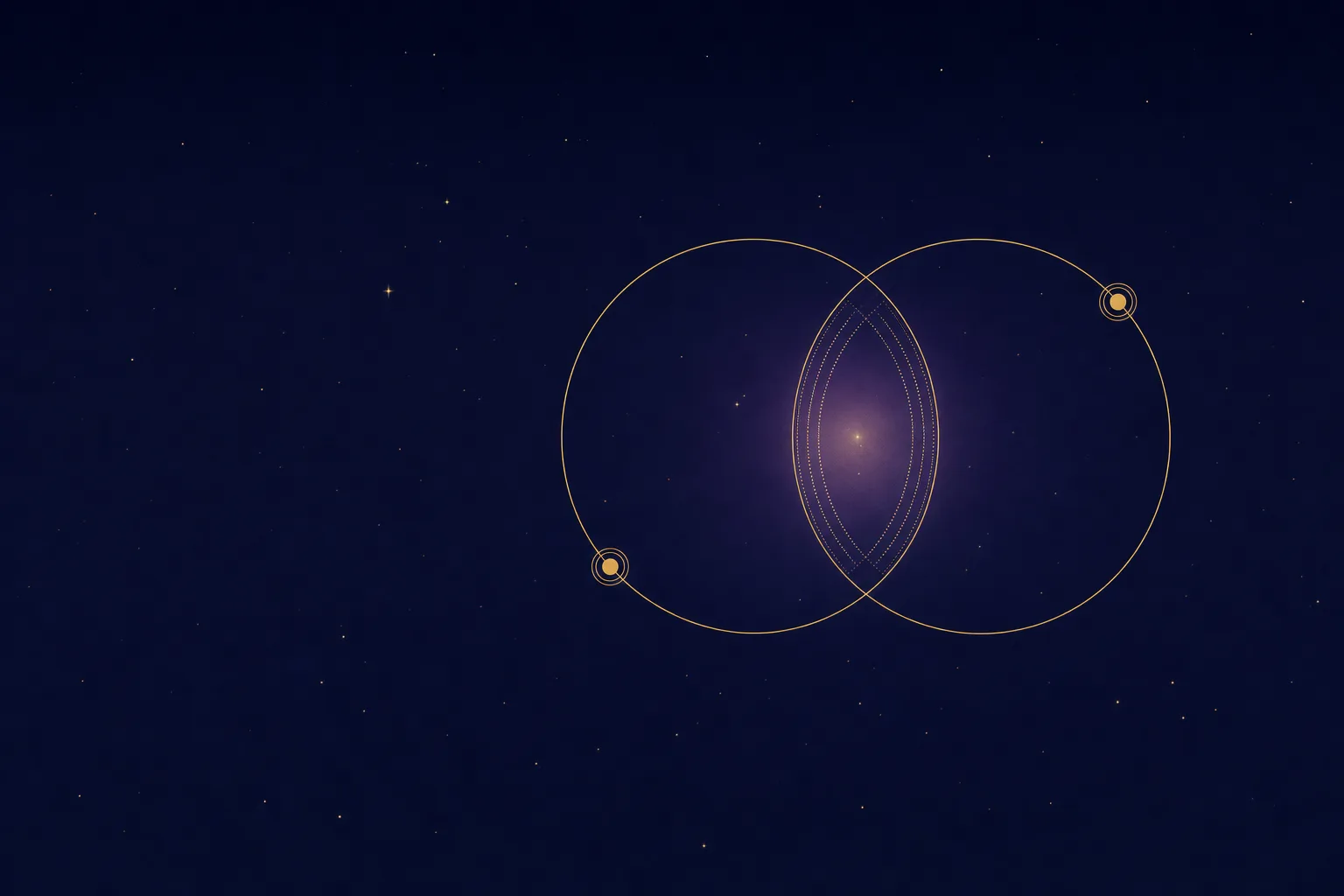
The oldest method is called synastry, from the Greek for stars standing together. You lay the two wheels over each other, one person's sky inside and the other's outside, and read the angles between the planets of the two, much as you read the aspects within a single chart.
Tradition watches a few contacts closely. Where one person's Sun meets the other's Moon, it reads familiarity, the feeling of being seen. Venus and Mars speak of attraction and of how two people want each other. Saturn on the other's personal planet counts as weight: commitment, sometimes strictness. None of these contacts is good or bad. They name themes.
With both birth times a second layer opens up: which of one person's houses do the other's planets fall into? If her Sun sits in his fourth house, it touches his sense of home and origin. Without the times that layer goes. What remains is covered in Birth time unknown.
Synastry and the composite chart
A younger method builds a third chart out of two. For the composite you take the midpoint of each pair of planets, the point halfway between her Venus and his Venus, and so on for every body. The result is a wheel that belongs to neither person but to the relationship itself. The approach became widely known in the 1970s, above all through Robert Hand.
Each route has its strength. Synastry shows how two people act on each other. The composite shows what the shared life looks like when you treat it as a being of its own. A careful report tells you which route it takes.
More than one wheel
Other systems compare too. In Human Design you look at how each of the two makes decisions, and at the channels that only exist when the two are together: one brings a gate, the other brings the gate opposite. The Chinese zodiac has traditional pairs of animals that support or chafe at each other. Numerology compares life path numbers. Each tradition has its own way of looking at what two people share.
Two skies do not add up to a score. They add up to a conversation.
Why there is no percentage
A percentage pretends that something was measured. The only thing measured is where the planets stood. Everything after that is interpretation, and interpretation does not add up. What is a Saturn on your Venus worth against a Moon on his Sun? Any answer is made up.
And the number knows nothing about you. Not how you met, not what you have come through together, not how you argue and how you make up. Two people with a supposedly difficult comparison can share a good life. Two with a supposedly easy one can walk straight past each other.
That is why Stellium Soul Connection does not measure whether you are a match. It gives your love no score, no percentages and no rank. Its connection map weights eight themes only in words: an image of how your two skies sound together on one theme. The report names the contacts each theme comes from, and a theme with fewer contacts is not a lack.
What the Soul Connection tells
The Soul Connection reads two skies first one by one and then together. It opens with your essence and ends with a letter:
- Your essence: a title for your connection, five answers, one central thought and a small next step.
- Your connection map: eight themes, from connection and recognition to spiritual meaning and growth, weighted in words, without numbers.
- Eight chapters, from "Why you touch each other" to "What this connection may mean to you", each with an impulse you can try if you like.
- An evening for you: a light idea for an evening together, nothing you have to do.
- Your couple letter: a personal letter to you both, to read aloud or to give.
The calculations are the same as in the Codex, with the Swiss Ephemeris as the source of the planetary positions. How each system is calculated is on the method page. What is new is the view between you: what is simply a trait in one person becomes, between two, a question of how two traits live together.
A word about the data. Whoever orders enters both sets of birth data and confirms with a tick that the other person agrees. Nobody has to create an account. You can share the finished report through a read-only link that shows no birth data. So ask before you order. The conversation about it is often where things begin.
Even a single sky says something about closeness. In the sample Codex of the invented Lea Brunner, the relationships field reads:
Relationships
In love and in what you value, you act gently, intuitively and with a lot of imagination.
Three questions for an evening together
With a report or without one, these three questions work at any kitchen table.
- When did you last feel truly understood by me, and what was I doing?
- Where do we make things hard for each other without meaning to?
- What would you like me to know better about you?
If you want to know more afterwards, read your two skies together with Stellium Soul Connection. One of you enters both sets of birth data, you pay once per couple, and the report arrives as a link by email.