The systems
What is a stellium in astrology?
Sometimes the sky crowds together. Three planets, four, in a single stretch of the wheel. What that means, and what it does not.
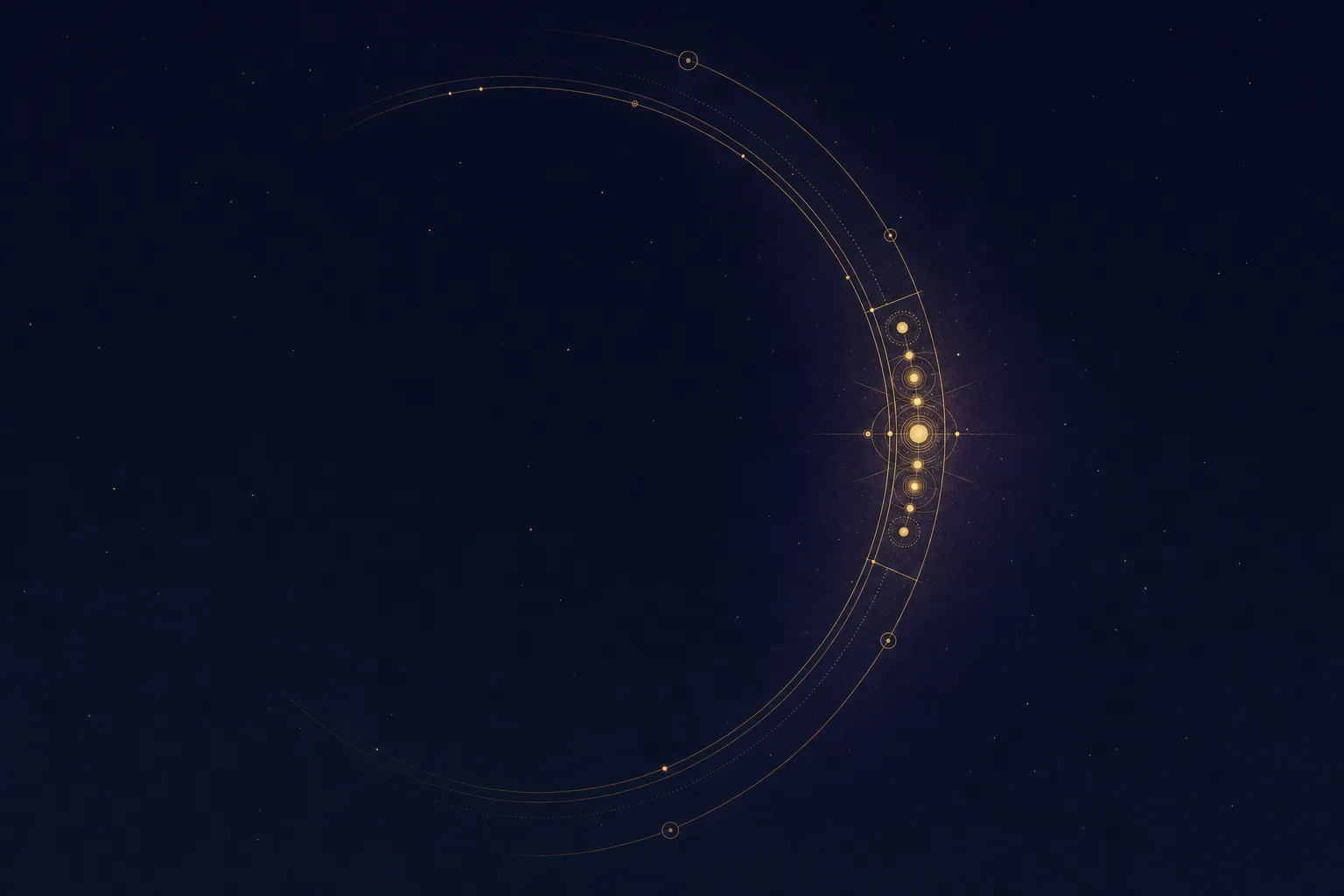
Look at most birth charts and the planets are scattered: one here, two there, a lot of empty sky in between. Now and then they gather. Three, four or more bodies sit close together in the same sign, as if they had agreed to meet. That gathering is called a stellium.
The word comes from the Latin stella, star. Older books also call it a satellitium. Both mean the same thing: one place in the sky where a lot is happening at once.
The definition, and where it is argued over
Most astrologers speak of a stellium when at least three planets share a sign or a house. Some want four. Nor is there agreement on what counts. The Sun and the Moon count almost everywhere. The lunar nodes, Chiron or the asteroids count for some readers and not for others.
A stricter school also wants the planets linked by conjunction, close to one another and not merely sharing thirty degrees of sign. So before you read a stellium, find out which rule is being used. A good report tells you.
Sign stellium and house stellium
There are two kinds, and they mean different things. A sign stellium stresses the character of a sign: the quickness of Gemini, the stamina of Capricorn, the openness of Pisces. A house stellium stresses an area of life, such as work, partnership or home. A house stellium needs a birth time, because the houses depend on the clock. More on that in Birth time unknown.
The two can coincide, but they do not have to. The chart of Lea Brunner shows it well. She is an invented person, born on 14 March 1989 in Zurich, and her chart holds three stelliums.
- Pisces: the Sun, Mercury and Venus, all three in the eighth house as well. Here the sign stellium and the house stellium are one.
- Gemini: the Moon, Mars and Jupiter. A sign stellium but not a house stellium, since the Moon sits in the eleventh house and Mars and Jupiter in the tenth.
- Capricorn: Saturn, Uranus and Neptune. Another sign stellium, spread over the fifth and sixth houses.
What a stellium means in a reading
A stellium is first of all emphasis. Whatever a sign or a house stands for gains weight, because several planets carry it, each with its own colour. In Lea's Pisces group, her core self (the Sun), her thinking (Mercury) and her way of loving (Venus) take on a similar tone. Tradition would say these three speak with one voice.
Emphasis has another side. Where a lot gathers in one place, something is missing elsewhere. People with a strong stellium often know the empty stretches of their own wheel just as well, the areas where nothing happens by itself. A careful reading names both.
Not every stellium is personal, either. The slow planets stay in one sign for years. Saturn, Uranus and Neptune spent long stretches of the late 1980s together in Capricorn, so Lea shares her Capricorn stellium with a great many people born in those years. Astrologers call that a generational stellium. A stellium built from the Sun, the Moon, Mercury or Venus is far rarer and far more your own.
A stellium is emphasis, not a verdict. It shows where your sky likes to look.
How the Codex reads a stellium
The Stellium Codex calculates the birth wheel with the Swiss Ephemeris, in the tropical zodiac with Placidus houses. It finds stelliums by sign and by house and tells you which bodies belong to each. Then it checks whether other systems point the same way. Where they do, the Codex calls it a convergence and gives it a word for its strength, never a number: quiet, moderate, clear or strong.
In Lea's case the Pisces stellium alone is not enough, because it comes from a single system. Her emphasis on water becomes a convergence only because a second interpretive perspective shows the same image: her day master in the Chinese chart is water, the element of Pisces. This is how her report puts it:
Water signature
The Gui day master of BaZi, Yin Water, adds a tone of adaptability: water takes the shape of its vessel and finds its way around obstacles.
- Western: Sun, Mercury, Venus and Pluto in water signs
- BaZi: Day master Gui, Yin water
How the other twelve systems calculate, from Vedic astrology to the tarot birth card, is set out on the method page.
How to find a stellium in your own wheel
With a table of your planetary positions you can check for yourself. Four steps are enough:
- Count how many planets stand in each sign. Three or more make a sign stellium.
- If you know your birth time, do the same for the houses. Three or more make a house stellium.
- Look at who is in the group. If the Sun, the Moon or the ruler of your Ascendant belongs to it, the stellium weighs more in a reading.
- Look at how slow the bodies are. If the group is only Saturn, Uranus, Neptune and Pluto, it is most likely generational.
Then do not read it on its own. A stellium says more once you know the element of its sign, the aspects that tie the group to the rest of the wheel, and which house opposite stays empty.
Why Stellium is called Stellium
The name is a picture of what the Codex does. Thirteen systems of interpretation, from different centuries and continents, look at the same moment of your birth. Most of the time they say different things. Sometimes they gather in one place, the way planets gather in a sign. That is where the Codex starts to speak.
That is why the Stellium mark is a ringed planet: Saturn, in the tradition the teacher of form and patience. It is a reminder that emphasis in the sky is no shortcut. It is an invitation to look more closely.
Do you have a stellium?
Only your own wheel can tell you. The Codex shows it, together with everything the other systems say about that place, and with one sentence that comes from your data alone. Lea's sample shows what that looks like. And if you want to see how the Codex turns many voices into a single statement, read on with Finding your life purpose.