The systems
Human Design in plain words: type, strategy, authority
Nine shapes, coloured in or left white, joined by lines. What the drawing shows, where it comes from, and what it cannot do for you.
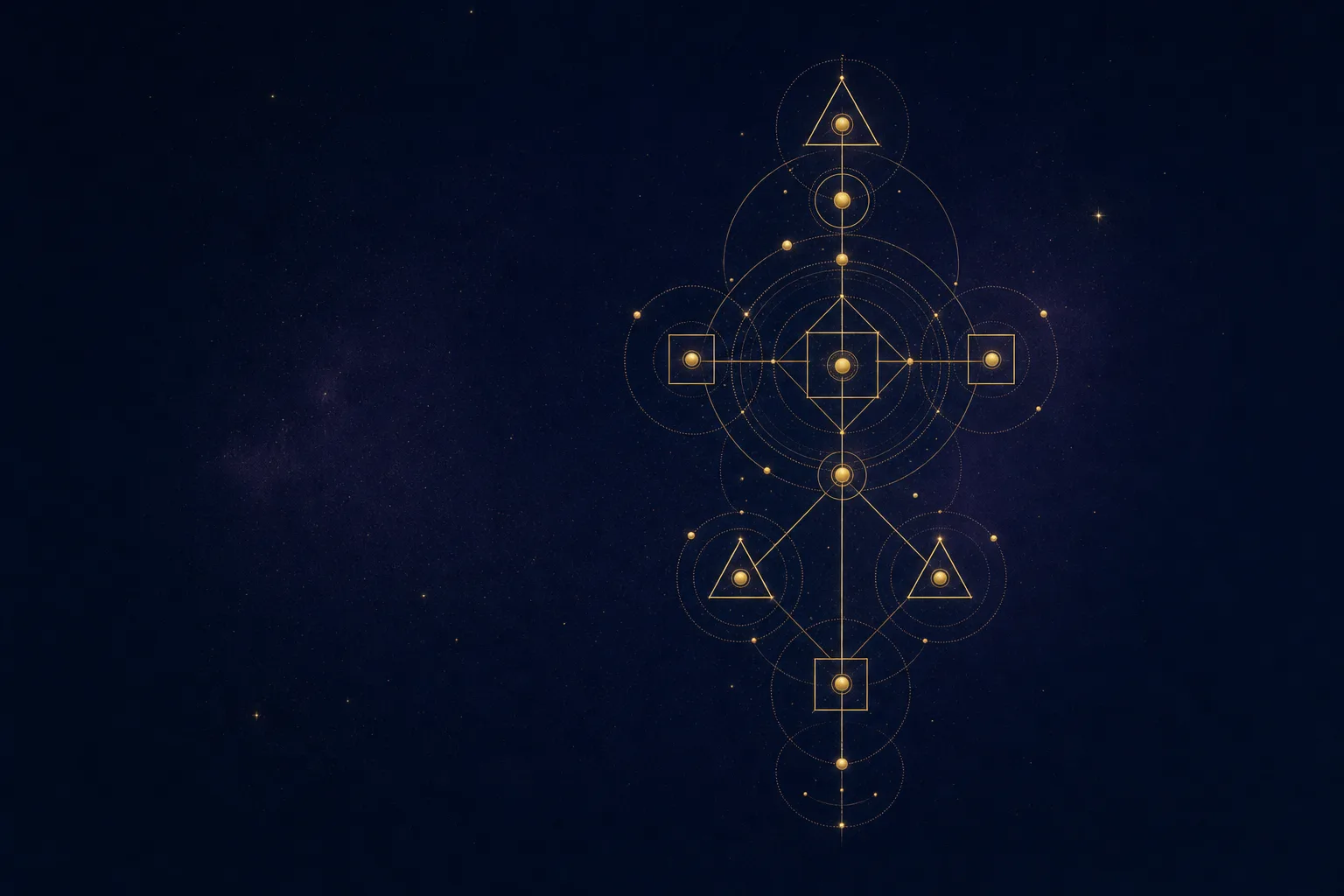
The first time you see a bodygraph, it looks like a circuit diagram. A human outline with nine geometric shapes inside, some coloured in, some white, lines running between them, numbers, two columns of red and black symbols. It looks technical. It is one of the most searched-for systems of our time, and one of the youngest.
Where Human Design comes from
Human Design comes from a man who called himself Ra Uru Hu. Born Alan Robert Krakower in Canada, he was living on Ibiza in the 1980s. There, in 1987, by his own account, he went through several days in which a voice dictated the system to him. Believe it or not, it cannot be verified, and Human Design is easier to understand if you read it as a modern synthesis.
Its building blocks are older. The planetary positions come from astrology. The 64 hexagrams of the Chinese I Ching become the 64 gates. The Kabbalah contributes the tree of life and its paths, Indian teaching the idea of energy centres, except that there are nine here instead of seven. On top come references to genetics and physics that Ra Uru Hu drew himself and that science does not share.
Two moments, one picture
Human Design works with two moments. The first is your birth. Its planetary positions are called the Personality and are drawn in black. The second comes earlier: the instant when the Sun stood 88 degrees further back along its path. Those positions are called the Design and are drawn in red.
Both sets of positions are laid on a circle, the Rave Mandala, which divides the zodiac into 64 gates of six lines each. Every planet activates a gate with a line, once for the Personality and once for the Design.
Centres, gates, channels
The bodygraph has nine centres: Head, Ajna, Throat, the G centre in the middle, Heart, Sacral, Solar Plexus, Spleen and Root. Between them run 36 channels, each with a gate at either end. When both gates of a channel are activated, the channel counts as defined, and the two centres it joins are coloured in.
In the system, coloured centres are what works in you reliably and in the same way. White centres count as open: according to Human Design, that is where you take in other people's energy, amplify it or learn from it. Open does not mean weak. It means receptive.
Five types and their strategy
The pattern of defined centres gives your type. What decides it is whether the Sacral centre is defined and whether a motor connects to the Throat. Each type comes with a strategy, a suggestion for how to meet life.
| Type | How you recognise it | Strategy |
|---|---|---|
| Manifestor | a motor connected to the Throat, Sacral open | inform before you act |
| Generator | Sacral defined, no motor to the Throat | wait to respond |
| Manifesting Generator | Sacral defined and a motor to the Throat | respond, then inform |
| Projector | Sacral open, no motor to the Throat, some definition | wait for the invitation |
| Reflector | no centre defined | wait out a lunar cycle |
Strategy is not an order. It describes how a type, in the system's terms, works least against itself. A Generator who waits to respond is not sitting idle. They notice what stirs something in them before they commit to it.
Authority: where a decision comes from
Authority answers a different question: what can you rely on when you decide? It follows from the ranking of your defined centres.
- Emotional: the Solar Plexus is defined. Clarity does not come in the moment but across a wave of moods. Sleeping on it helps.
- Sacral: a gut response in the moment, often a sound before any word.
- Splenic: a quiet, quick hunch that speaks only once.
- Ego: what you truly want and can stand behind.
- Self-projected: you hear yourself speak and notice what rings true.
- Environmental: without an inner authority in the narrow sense, talking it over and the right place help.
- Lunar: for Reflectors, across the Moon's whole round.
The profile
The profile is two numbers: the line of the Personality Sun and the line of the Design Sun. There are twelve profiles, from 1/3 to 6/2. Each line has a name and a role, such as the Investigator, the Hermit or the Opportunist. In the system, the profile describes how you meet others and how your path tends to unfold.
On an example
Lea Brunner is an invented person, born on 14 March 1989 at 14:35 in Zurich. Her bodygraph has five defined centres: Throat, G, Heart, Solar Plexus and Sacral. Because the Sacral is defined and a motor reaches the Throat, she is a Manifesting Generator. Her strategy: respond, then inform. Because the Solar Plexus is defined, her authority is emotional. Her profile is 2/4, Hermit and Opportunist. This is how her Codex puts it:
Human Design
Human Design shows a Manifesting Generator, a living sacral energy joined with speed and versatility. The strategy is to respond and then inform, and steps may be skipped or changed.
Her whole bodygraph, with channels, incarnation cross and the Gene Keys beside it, is in her sample Codex.
A type is not a box. It is a suggestion for how to deal with yourself.
Human Design in the Codex
In the Stellium Codex, Human Design is one of thirteen systems. The planetary positions come from the Swiss Ephemeris, and the mapping to gates and lines follows the publicly known values of the Rave Mandala. The Codex shows type, strategy, authority, defined centres, channels, incarnation cross and variables, with a bodygraph. The Gene Keys read the same gates, so the two sit side by side in the Cosmic Atlas.
One honest note belongs here. When a planet sits right on the border between two gates or lines, different programs can assign it differently. The Codex tells you so at that point. How all thirteen systems are calculated is on the method page. And where Human Design joins the birth chart and the Maya calendar in speaking about purpose, read Finding your life purpose.