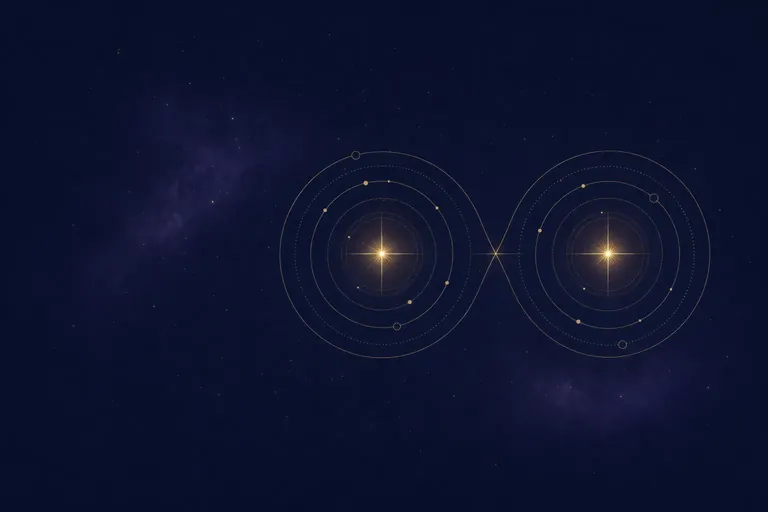
As a couple
Synastry chart: composite chart vs synastry, and how to read both
Lay two skies over each other, or build a third from them: two ways astrology reads what lies between two people.

Two people, two birth charts. That is all astrology needs to speak about a relationship. But it has two very different tools for the job. One is called synastry, the other the composite. Both turn up in every conversation about partnership, and they are often mixed up.
Here you can see what each tool calculates, what the tradition reads into it, and where interpretation stops. Once you know both, a couple's chart becomes calmer to read and more interesting to question.
The synastry chart: two skies, one over the other
The word comes from Greek and loosely means “together stars”. In synastry both birth charts stay as they are. You lay them over each other, like two transparent wheels, and ask: where does a planet of one person meet a planet or point of the other?
What gets calculated are the aspects between the two charts: conjunction, opposition, trine, square, sextile. Then comes the question of which house of one chart the other person's planets fall into. A synastry chart keeps two perspectives side by side.
That is why synastry often sounds personal. It has two voices. Your Moon may land on the other person's Saturn while their Moon lands on your Venus. Each side tells a different story, and both hold.
The composite chart: a third picture
The composite works differently. It does not overlay anything, it builds something new. For each pair of planets the midpoint on the zodiac is worked out: the midpoint of the two Suns, the two Moons, the two Venuses, and so on. Those midpoints form a wheel of their own.
The tradition reads this wheel as if the relationship itself were a being with its own Sun, its own Moon and its own way of feeling. It is a symbolic picture. That sky never existed, and nobody was born under it. It is a sum that serves as a mirror.
For the houses, the composite needs both birth times. Without them the picture stays incomplete, and the reading has to rest on signs and planetary angles.
Composite chart vs synastry at a glance
| Feature | Synastry | Composite |
|---|---|---|
| What emerges | Two charts overlaid | A new, third chart |
| What is calculated | Aspects and houses between the charts | Midpoints of every planet pair |
| The question | What do you stir in each other? | What is the character of this bond? |
| Viewpoint | Two voices | One shared voice |
People who search for composite chart vs synastry often want a verdict on which is better. The tradition sees them as partners. Synastry describes the friction and the pull between two people. The composite describes the tone the bond carries as a whole.
One image: synastry is the conversation of two people at a table. The composite is the room the table stands in.
What the tradition reads into them
In synastry, contacts between the personal planets count as lively: Sun, Moon, Mercury, Venus, Mars. A Moon-Venus trine is read as softness, a Sun-Saturn square as seriousness and testing. The ascendant matters too, because it describes how a person meets the world.
In the composite, readers look mostly at the Sun, Moon and ascendant of the bond. A composite Sun in Pisces speaks, in the tradition, of a relationship that shares moods. A composite Moon in Capricorn speaks of one that needs reliability in order to feel at ease.
These are images, not findings. They are old, and many astrologers have described them, among them Robert Hand and Stephen Arroyo. They invite reflection. They do not say how a relationship will go.
How such a picture can sound
A couple's chart always begins with two individuals. So it helps to hear first how a single chart speaks. This is how the sample report of Lea Brunner, an invented person, reads her way of loving:
Relationships
In love and in what you value, you act gently, intuitively and with a lot of imagination.
Imagine that sentence meeting a second chart. Synastry then asks whether the other side takes in that gentleness or overlooks it. The composite asks what tone arises when two ways of loving become one.
When each tool helps
Synastry suits the wish to understand what two people stir in each other: why a conversation comes easily, why one theme keeps returning, why a closeness feels familiar. The composite suits an interest in the shared whole: the character of a friendship, a partnership, a project for two.
The two do not compete. Reading only synastry, you see two persons and lose the bond. Reading only the composite, you see the bond and lose the persons. Together they give a picture with a foreground and a background.
What to look for as you read
- Look for repetition. A single aspect says little, a theme that speaks from several places says more.
- Mind the orb. The tighter an angle, the more weight the tradition gives it.
- Read both directions. What your Moon does to the other person is not what their Moon does to you.
- Do not take tension as a verdict. In the tradition a square is also a source of drive.
- Check the birth time. Houses and ascendant depend on it.
How the calculation runs in detail is described on our method page. There you can also see which data we need.
Why a number is not enough
Many sites online give couples a percentage. It looks clear, but it is a shortcut. A trine between two Moons and a square between two Suns cannot be added into one figure without losing the story between them.
A couple's chart is not a report card. It is a conversation that has already begun.
The tradition knows no percentages. It knows images, opposites and room to move. More on the topic is in Couple chart: what comparing two skies shows and, if closeness is the question that moves you, in Soulmate astrology report. Speaking of soulmates is always an interpretation, never a fact.
If you would like to read both skies
The Stellium Soul Connection is the couple report built from two birth charts. It sets synastry and the shared picture side by side, tells in calm words what the tradition sees there, and needs no score and no percentage.
To see what a full report looks like, open the sample report. Questions about data and process are answered in the FAQ.