Learning to read
Rising sign meaning: what your ascendant shows
Your rising sign is the doorway of your birth chart: the point on the horizon where your sky begins.
Most people know their Sun sign by heart. The rising sign is quieter. Yet it is the point where a birth chart begins: the sign that was climbing over the eastern horizon as you arrived. Anyone who goes looking for an ascendant is really looking for a threshold. Here you can read what is calculated, what tradition sees in it, and where every interpretation has to stop.
What the ascendant is
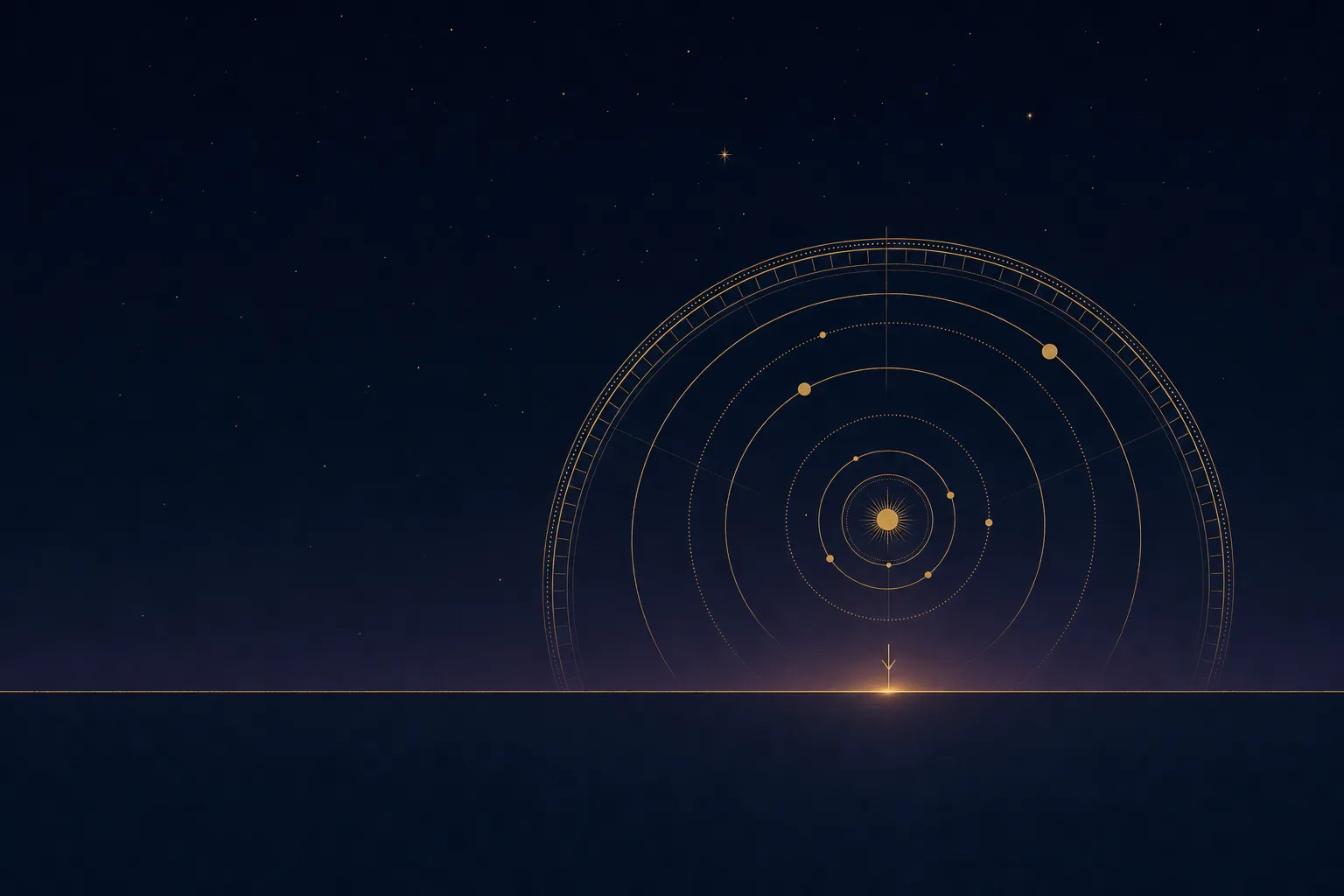
Picture the sky above your birthplace. On the eastern horizon, one point of the ecliptic is rising at every moment. The ecliptic is the path along which the Sun, Moon and planets travel. That point sits in a zodiac sign at a particular degree. It is your ascendant, also called the rising sign.
It marks the start of the first house. The whole wheel is drawn from it, and opposite it lies the descendant, the setting point. Your Sun sign shows which part of the zodiac the Sun was crossing on your birth date. Your rising sign shows which sign met the horizon at your birth hour. Two places in the sky, two different questions.
What is calculated
An ascendant is not a guess or a feeling. It is geometry. Three facts are enough: date, clock time and place of birth. The place gives longitude and latitude, the time gives sidereal time, and together they give the angle at which the ecliptic cuts the horizon.
Because the sky turns once a day, the rising sign changes about every two hours. Two people born on the same day in the same city can therefore have very different ascendants. Stellium works from the Swiss Ephemeris, a well-known set of astronomical tables. How that fits together is described on the page about our method.
Why the birth time matters so much
The Sun moves about one degree a day. The ascendant moves through the entire zodiac in a day. That is why it is the most time-sensitive point in the chart, and why a few small errors in the clock time can move it into the next sign.
- Time zones and daylight saving: a birth in the past may follow rules that differ from today's. Good software holds the historical data.
- Birthplace: two cities at different longitudes give different degrees. Name the town, not just the country.
- The source of the time: a birth certificate or hospital record usually beats memory. Family stories are a starting point, not proof.
If your time is only roughly known, the ascendant becomes uncertain. Our piece on an unknown birth time shows what the chart still tells you.
What tradition reads in it
Here interpretation begins, and it is old. In Hellenistic astrology the rising point was treated as the most important place in the chart. Ptolemy and other ancient authors link it to life and the body, and to the starting point from which everything else is read.
Modern astrology turned this into an image: the ascendant is the way you walk into a room. A mask, some say. A window, say others. In this reading a Leo rising enters visibly and warmly, a Cancer rising carefully and receptively, a Capricorn rising calmly and with a testing eye. The ruler of the sign matters too. Where it stands by sign and house adds further colour.
The Sun says who you want to be. The rising sign says how you come through the door.
This is one way of reading, not a law of nature. It invites observation: do you recognise yourself in it, or do others recognise you?
Rising sign and Sun in conversation
A birth chart is made of relationships, not single parts. The ascendant alone is the start of a sentence. Only with the Sun, Moon, the houses and the aspects does it become a thought.
Sometimes Sun and rising sign agree and the picture feels whole. Sometimes they sit far apart, say a Scorpio Sun with a Gemini rising. Then much of what happens inside may run deeper than what shows outside. Tradition does not call that a flaw. It calls it a tension that makes a chart alive.
A good reading explains these links in words rather than listing signs. What belongs in one is covered in what a birth chart reading should contain.
An example from Lea's chart
Lea Brunner is an invented person, used to show how a Stellium Codex sounds. Her chart holds a Gemini Moon and a feeling world that wants words. This is how her report reads that Moon:
Western astrology
Your Moon in Gemini keeps a window open in the house of feeling, so that every mood wants to become a sentence before it settles.
Notice the tone. Nothing is declared as a verdict. The chart element is offered as a colour and set beside others. You can look at the whole report in the sample report.
Three questions for reading your own
- Which sign and which degree are rising? If the degree sits at the very start or end of a sign, check the birth time with care.
- Where is the ruler of that sign? Its house and aspects show where the ascendant's energy travels.
- Which planets stand close to the ascendant? A planet in the first house often colours your entrance more than the sign does.
Write down your answers and hold them against your week. Not as a test, more like a notebook: what fits, what does not?
If you would like to meet your rising point
In the Stellium Codex your ascendant does not stand alone. It sits inside a personal birth chart book of about 60 pages, as a web report and a PDF. The FAQ answers questions about the calculation. Take your time with the sample, then decide whether you would like to read your own sky.